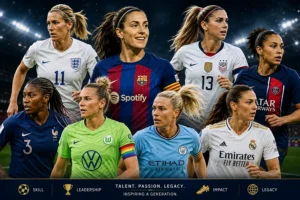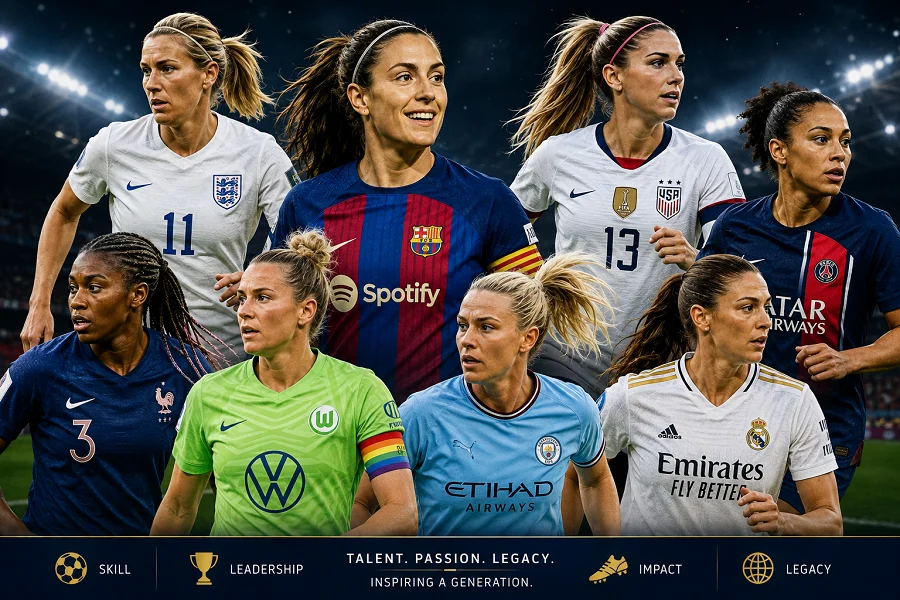
Women’s football has never been more competitive at the very top, and the calibre of talent currently playing across Europe’s leading leagues makes picking out the genuine elite a genuinely difficult task. From record-breaking individual honours to sustained club dominance, a handful of players have separated themselves from the pack through consistency, technical brilliance and an ability to perform on the biggest stages. This article looks at the players currently regarded as the best in the world, what has made them so exceptional, and how the race for the sport’s top individual honour looks heading into the rest of 2026.
Aitana Bonmatí: the record-breaker
No player has dominated the individual conversation in women’s football quite like Aitana Bonmatí in recent years. The Barcelona midfielder won the Ballon d’Or Féminin in 2023, 2024 and 2025, becoming the first woman in the award’s history to win it three consecutive times. Bonmatí combines the vision and intelligence of a genuine playmaker with a finishing instinct that few midfielders anywhere in the world can match, and her technique, balance and composure on the ball have made her the defining player of her generation. An injury-disrupted 2025-26 season has made her path to a fourth consecutive award considerably harder, but her body of work over the preceding three years remains unmatched in the sport’s modern history.
Alexia Putellas: the leading contender for 2026
Before Bonmatí ever touched the trophy, it belonged to her Barcelona teammate Alexia Putellas, who won the Ballon d’Or Féminin in both 2021 and 2022. After working her way back from a serious knee injury, Putellas has enjoyed a remarkable 2025-26 campaign, marking her 500th Barcelona appearance in April with a goal and two assists in a Champions League Clásico victory over Real Madrid. Her vision, passing accuracy and leadership have made her the clear front-runner for the 2026 Ballon d’Or Féminin, which will be presented in London for the first time in the award’s history in October 2026.
The Barcelona dynasty
What makes both Bonmatí and Putellas’ achievements even more striking is the broader context: Barcelona have produced the winner of the Ballon d’Or Féminin for five consecutive years between 2021 and 2025, a run of dominance that no other club has come close to matching. This sustained success reflects the club’s investment in its women’s setup and its ability to develop and retain world-class talent across midfield and attack, building a squad depth that has made Barcelona the benchmark for other clubs across Europe to measure themselves against.
Beyond Barcelona: the chasing pack
While Barcelona’s midfield duo have dominated individual honours, several players from outside the club have established themselves among the world’s elite. Alessia Russo has continued to develop into one of the most dangerous forwards in the game, narrowly missing out on the Ballon d’Or Féminin the previous year and remaining a genuine contender heading into 2026. Ewa Pajor and Caroline Graham Hansen have both produced standout campaigns in attack, while Patri Guijarro’s performances in central midfield, including a standout display and assist in a Champions League final, have pushed her into serious contention for a top-six finish in the voting.
England’s representation at the top level
English football has its own representatives among the game’s elite too. Hannah Hampton was named the world’s best women’s goalkeeper at the 2025 Ballon d’Or ceremony, recognition of a season in which she established herself as one of the most reliable shot-stoppers in the sport. Sarina Wiegman, the Lionesses’ head coach, was named women’s coach of the year at the same ceremony, underlining the strength of the coaching setup behind England’s continued success on the international stage.
What separates the very best from merely excellent players
Looking across this group of players, a few consistent qualities stand out. Goals and assists matter, but so does performance on the biggest occasions, particularly in the UEFA Women’s Champions League, where the world’s best sides and players are tested against one another most directly. Voters and analysts consistently point to statistical markers like progressive carries and touches in dangerous areas, but the players who separate themselves from the pack combine this technical output with genuine leadership and the ability to elevate teammates around them during periods of injury or transition, exactly what Putellas has done for Barcelona during Bonmatí’s recent injury absence.
The growing depth of women’s football
Perhaps the most encouraging sign for the sport’s future is how genuinely open the conversation about the world’s best player has become. Where a small handful of names might once have dominated every shortlist, the current landscape includes serious contenders from multiple clubs and countries, reflecting the investment and professionalisation that has swept through women’s football england and across Europe more broadly in recent years. This depth benefits the sport as a whole, creating more competitive leagues, more compelling individual storylines each season, and a genuinely unpredictable race for the game’s top individual honour.
Why the 2026 award race looks so different
With no major international tournament scheduled for 2026, domestic league performances, domestic cup competitions and the Women’s Champions League are expected to carry significantly more weight in determining this year’s Ballon d’Or Féminin winner than in years featuring a World Cup or European Championship. This shift in emphasis has genuinely opened up the race, giving players who might otherwise be overshadowed by international tournament performances a clearer path to individual recognition based purely on their club form across a full season.
Conclusion
The current generation of elite female footballers, led by Barcelona’s remarkable midfield duo of Aitana Bonmatí and Alexia Putellas, has taken the individual standard in women’s football to genuinely unprecedented heights. With serious challengers emerging from clubs across England, Germany and beyond, and a Ballon d’Or Féminin race in 2026 that looks more open than it has in years, the conversation about who truly deserves to be called the best in the world has rarely been more compelling, or more difficult to settle.